GLITS and BLITS are two broadcast-standard test tone sequences that most audio engineers have encountered but few have had a convenient way to generate from scratch.
GLITS - Group Line-up and Identification Tone Sequence - is the BBC/EBU stereo alignment standard. It runs as a 4-second cycle of 1 kHz tone at -18 dBFS on both channels, with timed interruptions on each channel in turn to identify left and right. It is the tone you hear at the top of a contribution feed or at the start of a tape, and it tells you the line is up, the levels are correct, and the channels are the right way round.
BLITS - Black & Lane’s Identification Tones for Surround - is the EBU Tech 3304 equivalent for 5.1 surround. It runs sequential 600 ms identification bursts, one per speaker position, using specific frequencies assigned to each channel, across a full 13.4-second cycle. It is used to verify that a 5.1 path is correctly routed end to end and that nothing has been swapped or dropped in the chain.
Both are well-defined standards. Generating them correctly - at the right level, with the right timing, with proper WAVE_FORMAT_EXTENSIBLE headers at 24-bit/48 kHz - has historically required either a DAW session, dedicated signal generator hardware, or a file sourced from somewhere else and hoped to be correct.
So I built a tool to generate them directly in the browser.
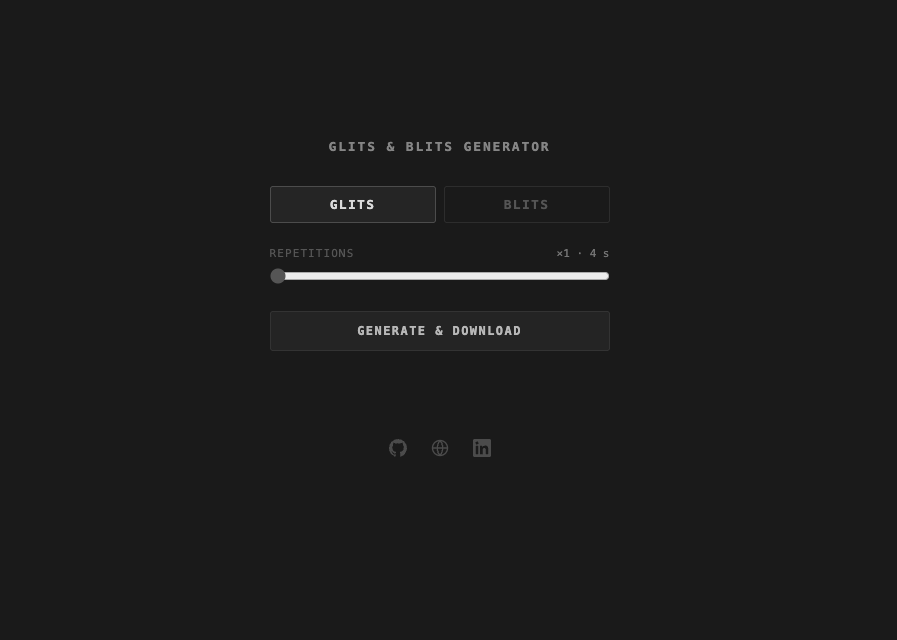
GLITS & BLITS Generator is a simple web application that produces compliant GLITS and BLITS sequences as 24-bit PCM WAV files at 48 kHz. Select the sequence type, set the number of repetitions, and download. All other parameters follow the EBU specifications and are not configurable - the point is to generate a correct, standard file, not to build a general-purpose tone generator.
The source is on GitHub and the project is MIT licensed.