IPMX - IP Media Experience

What Is IPMX, and Why Could It Change AV over IP?

The broadcast industry spent the better part of a decade converging on ST 2110 and NMOS as the open standards for professional media over IP. The Pro AV industry - corporate, higher education, live events, hospitality, digital signage - has been having a parallel conversation, mostly in private, and mostly arriving at proprietary conclusions. SDVoE, Dante AV, NDI, AVoIP chipset ecosystems from various manufacturers: each solves the AV distribution problem, none of them solve it in the same way, and none of them interoperate with each other or with broadcast infrastructure. If you have ever tried to connect a corporate AV system to a broadcast facility, or route signal between a proprietary HDMI-over-IP encoder and an ST 2110 infrastructure, you will understand the problem immediately. ...
April 11, 2026 · Matt Thomas
Docker

Docker Basics for Broadcast Engineers

Broadcast IP infrastructure increasingly relies on software-defined components - NMOS registries, stream monitors, timing tools, test utilities. Getting these running on a server traditionally means installing dependencies, resolving version conflicts, and documenting the exact steps so someone can reproduce the environment six months later. Docker changes that. It packages an application and everything it needs into a single portable unit that runs the same way regardless of what is already installed on the host. ...

April 6, 2026 · Matt Thomas
NMOS IS-08 Audio Channel Mapping

NMOS IS-08: Audio Channel Mapping

IS-05 handles making the connection between a sender and a receiver. Once that connection exists, a multi-channel audio flow is arriving at the receiver - but which channels end up on which outputs is a separate question, and IS-05 has nothing to say about it. That is the gap IS-08 fills. It is the NMOS specification for audio channel mapping: a standardised API for controlling how the audio channels within a received flow are routed to the physical or logical output pins of a device. ...

April 6, 2026 · Matt Thomas
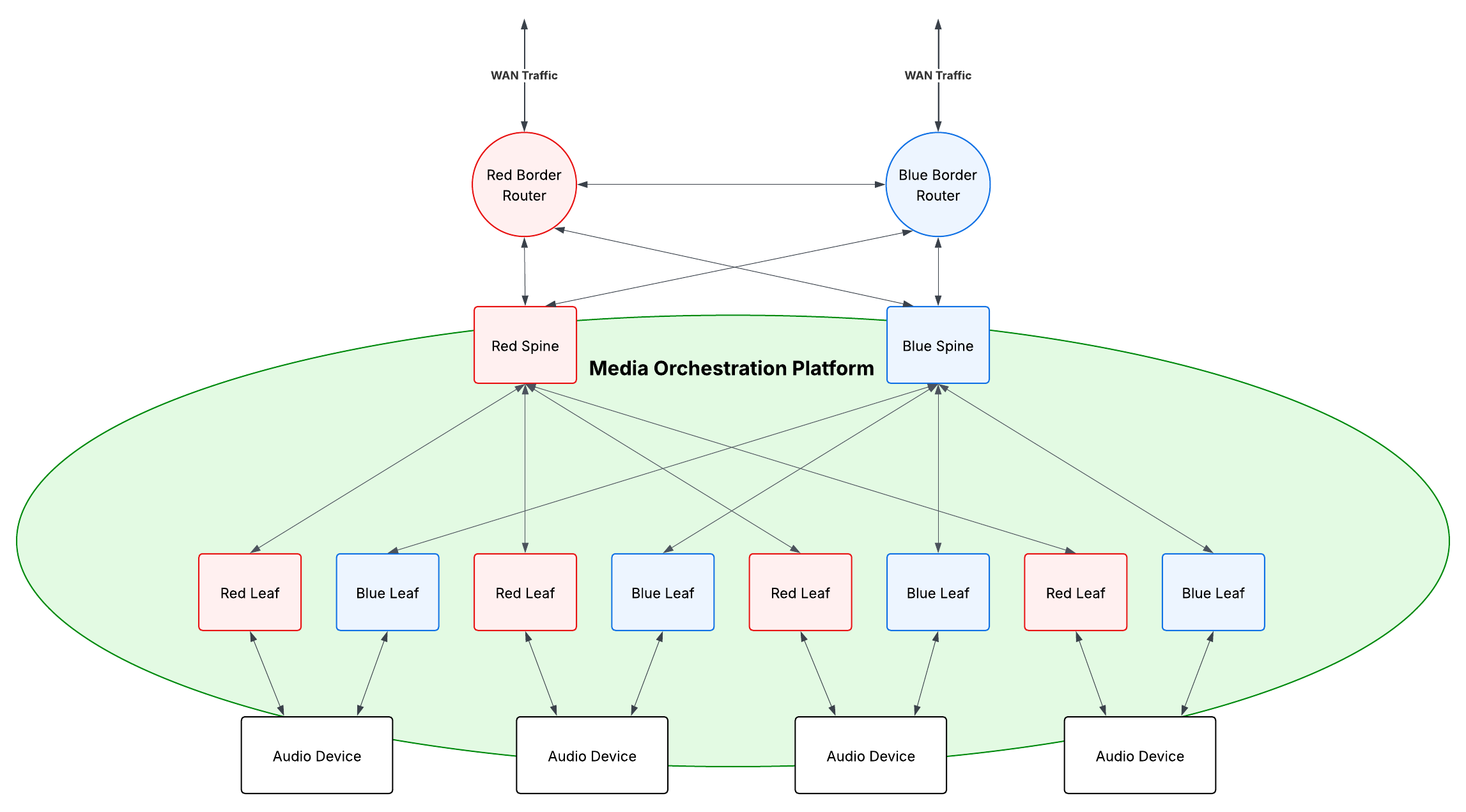
Media orchestration platform architecture diagram

Media Orchestration Platforms in IP Broadcast Facilities

Building a spine-leaf ST 2110 network solves the transport problem. Signals can flow anywhere in the facility at the speed of light with predictable latency. What it does not solve is the control problem: how do operators actually route those signals, how does the system know what resources are available, and how does automation talk to the infrastructure in a consistent way regardless of which vendor made each device? That is what a media orchestration platform does. It is the software layer that sits above the network and provides a unified means of controlling everything connected to it. ...

April 5, 2026 · Matt Thomas
NMOS - Networked Media Open Specifications

What is NMOS, and Why Does It Matter for AoIP?

One of the things I find interesting about the broadcast industry’s move to IP is how the conversation tends to focus on transport. Ravenna, AES67, ST 2110 - these are protocols for moving media across a network, and they’ve matured significantly over the last decade. But transport is only part of the picture. Once you have dozens or hundreds of IP devices on a network, you need answers to some fairly fundamental questions. How do applications know what devices are available? How do you make a connection between a sender and a receiver? How do you change that connection, and when does the change take effect? ...

March 29, 2026 · Matt Thomas