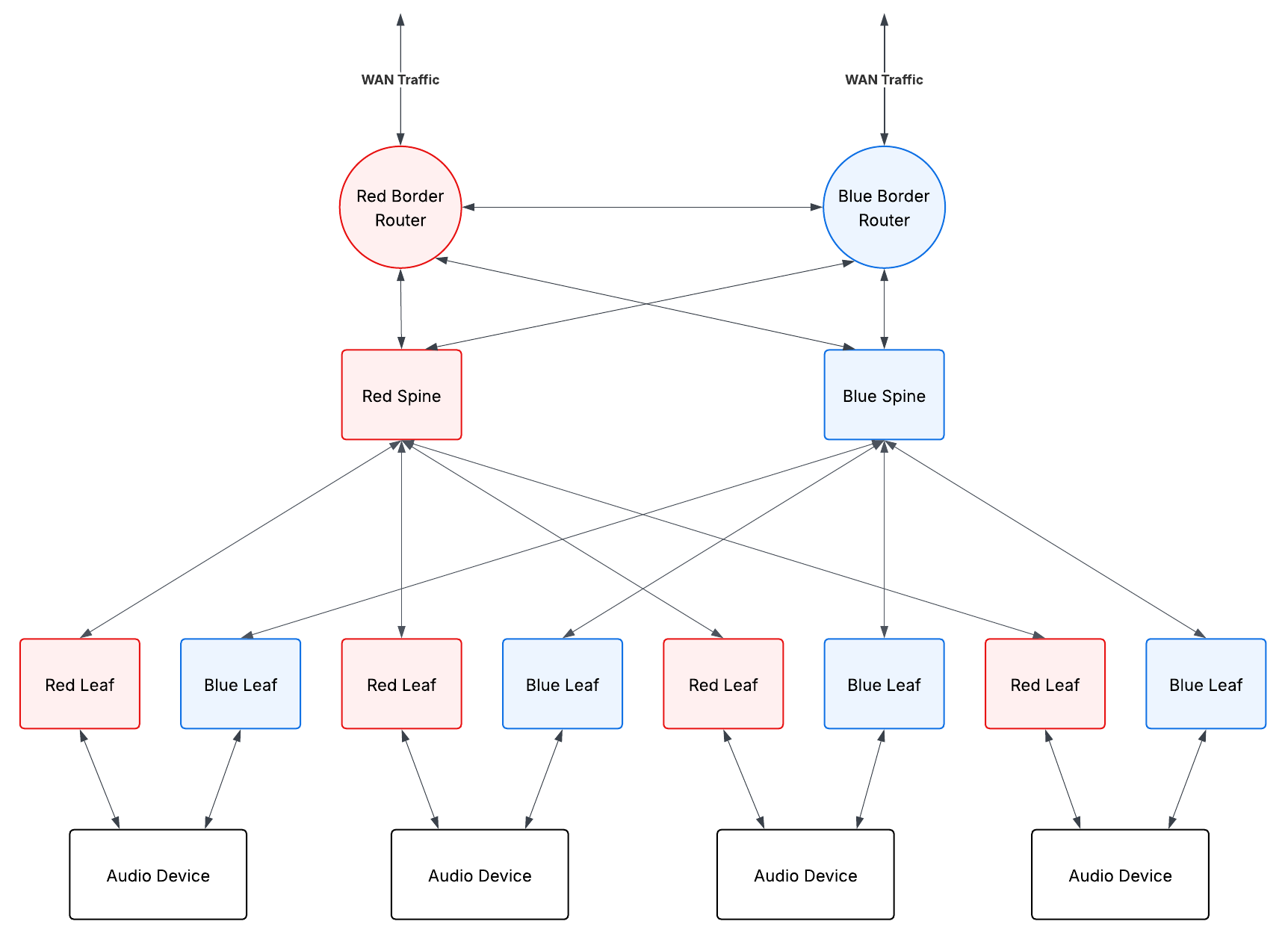
The Role of a Border Router in Spine-Leaf Media Networks
Spine-leaf has become the dominant topology for IP media networks in broadcast facilities, outside broadcast trucks, and stadium infrastructure. It is predictable, scalable, and well-suited to the low-latency, high-bandwidth demands of uncompressed media. But a spine-leaf fabric is, by design, a closed system. The border router is what connects it to everything else. Spine-Leaf in Brief In a spine-leaf topology, every leaf switch connects to every spine switch. There are no direct connections between leaf switches, and no direct connections between spine switches. Traffic between any two endpoints always takes the same number of hops - leaf to spine to leaf - which gives you consistent, predictable latency across the fabric. ...